Letter of demand to Minister of Agriculture: FSA and other agricultural role players take legal action over FMD vaccines
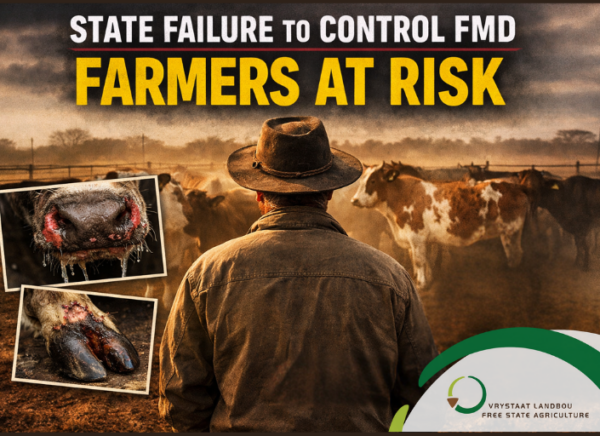


Free State Agriculture (FSA), together with key players in the agricultural industry including the Southern Africa Agri-Initiative (SAAI) and Sakeliga, have initiated formal steps through their legal representative to break the state’s monopoly on the procurement and administration of foot-and-mouth disease (FMD) vaccines.
The organisations earlier this week sent a letter of demand to the Minister of Agriculture and senior government officials demanding that it be confirmed in writing by 30 January 2026 that livestock farmers may procure and administer private vaccines, in collaboration with state and private veterinarians. “This step follows months of silence, uncertainty and increasing outbreaks under a fully centralised, state-run system that has clearly failed,” says Francois Wilken, president of Free State Agriculture. “The survival of South Africa’s livestock farming and meat industry is now directly at risk.”
The organizations involved represent their members and supporters with the aim of protecting their constitutional rights, including the right to freely practice a profession or trade, the right to property and the right to human dignity. According to Wilken, these rights are currently being seriously violated by a FMD outbreak that has rapidly spread across several provinces and is already so out of control that the Minister of Agriculture himself indicated that a national state of disaster is being considered.
During a media conference on 14 January 2026, the Minister announced that the state’s strategy aims to vaccinate the entire national livestock herd. However, farmers are still waiting for a clear, feasible plan and timeline. “Ironically, the Minister acknowledges that access to vaccines is central to the solution, while that access is still restricted by the state,” says Wilken.
The letter of demand highlights the following key concerns, among others:
According to the role players, there are reliable vaccine suppliers who are ready and able to supply the private sector. “Allowing this is the logical and necessary step to give farmers a measure of control and stability again,” says Wilken. “The situation is so critical that a significant proportion of livestock farmers are already facing the immediate danger of total business collapse. Making vaccines available to the private sector will in no way prejudice the state’s access to vaccines.”
Wilken points out that another major source of concern is the delay in issuing permits under Section 21 of the Medicines and Related Substances Act, 1965 (Act 101 of 1965) to private companies. Although the Minister claims that the private sector is already being involved in imports, there is uncertainty as to whether farmers will be able to directly obtain vaccines and administer them themselves within the existing network of state and private veterinarians. “These delays raise serious suspicions about the sincerity of the state’s actions and must be addressed immediately,” warns Wilken.
Wilken further emphasizes that the current regulations and protocols unreasonably restrict farmers from trading normally and surviving financially. “These rules were not designed for the current reality and could plunge many farmers into financial collapse.”
“This is not a ten-year planning exercise. This is a war against a virus,” says Wilken. “Farmers cannot wait any longer while the disease spreads unchecked. The state itself has admitted that it does not have the capacity to manage this crisis alone.”
“If no favorable response is received by the deadline, further legal action will be considered. This step has been taken solely in the interest of the industry, food security and the broader economy,” concludes Wilken.
8Posts
4Posts
11Posts
9Posts
68Posts
31Posts
16Posts
18Posts
11Posts
17Posts
189Posts
18Posts
13Posts
Join us today for the freedom to farm with peace of mind.